
‘The Great Flood’ Review – Netflix’s Korean Disaster Movie Isn’t What It Seems
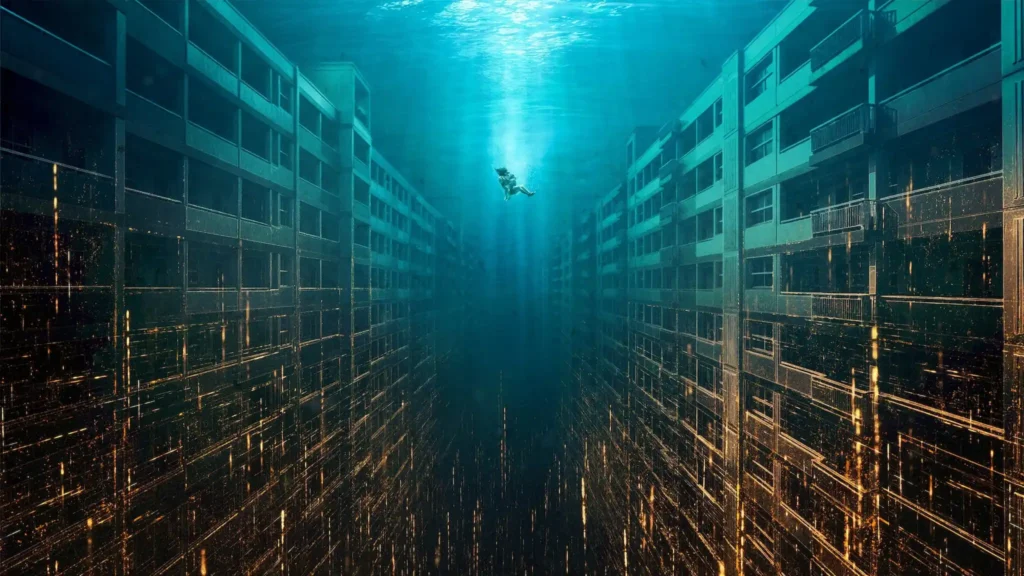

The Great Flood starts out as a very compelling disaster movie, but it almost becomes a disaster of a movie on the back of its own confounding ambition. It’s also the critics’ least favourite movie to write about, since it’s built on a series of escalating twists and revelations that continually upend its structure and redefine its genre, making it impossible to talk about without spoiling. Not that you could concretely spoil it, since it’s so rife with ambiguity and double-meaning that parsing what it’s really about is more an exercise in theorising than straight-up media literacy.
I’ll be cagey, then. Director Kim Byung-woo has, if nothing else, really gone to town here, in terms of both splashy visual effects and radically ambitious ideas. In the early-going, An-na (Kim Da-mi) is woken up in her apartment by her remarkably annoying son, a goggles-wearing diving obsessive who never stops talking and running into things, but she’s shocked to discover that his claims of the outside world having turned into a swimming pool are scarily accurate. Immediately, I began to hold out hope that the kid might be swept away by a lashing wave, but that turned out to be the least of his problems.
This stuff? Excellent. It’s framed like a typical disaster scenario, with water lapping the third floor of an apartment block that is rapidly being consumed by a climbing deluge. An-na, under instruction from a security agent named Hee-joo (Squid Game’s Park Hae-soo), has to drag her son up each floor of the building, staying ahead of the water, in the hopes of being safely rescued from the roof. That sounds like a movie-long premise, but it’s only the tip of the iceberg, since An-na is a crucial player in an ambitious sci-fi effort to save the world from disaster, and everything we’re seeing isn’t exactly what it seems.
But no more about that. The Great Flood is built on what transpires after this, as the movie adopts a Groundhog Day-style recursive structure to analyse an extremely speculative concept. But even then, it continues to expand outwards and then collapse back in on itself with pulse-like consistency, maddeningly redefining the terms of its own narrative and characters. It never for a moment stops being interesting and engaging, but it did reach a point, at least for me, where it just became too out-there to really enjoy, and certainly to think about afterwards.
It’s very well-made, at least. The human melodrama isn’t always especially convincing, but the orchestration of the big set-pieces is excellent, with real nerve-jangling stretches of sustained tension that make me long for the straightforward disaster movie this could have been. That tendency to bite off more than a movie can chew isn’t unique to Korean film, but it seems to be common enough – especially on streaming – to warrant a mention, with Jung_E feeling oddly similar in how its reach far exceeded its grasp.
The Great Flood – a title redolent with Old Testament doom-mongering, and not by accident – is also a movie of many influences, most worn proudly on its sleeve. Interstellar is very much here, as is the aforementioned Groundhog Day, and the nested Matryoshka quality evokes Inception. But you’ll notice those were all single movies, with their entire runtime devoted to a core concept. An amalgamation of all those ideas in a sub-two-hour runtime is detrimentally chaotic and unwieldy, and The Great Flood quickly becomes a cautionary tale about not just cramming together a bunch of stuff that worked in other movies and hoping it’ll work in this one.
As a spectacle and a conversation-starter, it’s impossible not to recommend The Great Flood. But it’s important to calibrate your expectations, since the conversation it starts may never end, and there’s a better-than-average chance it won’t end up going anywhere fruitful.